The 'Terms and Conditions - Privacy Policy' tab in Settings is where you set the general T&Cs and Privacy Policy for your organisation.
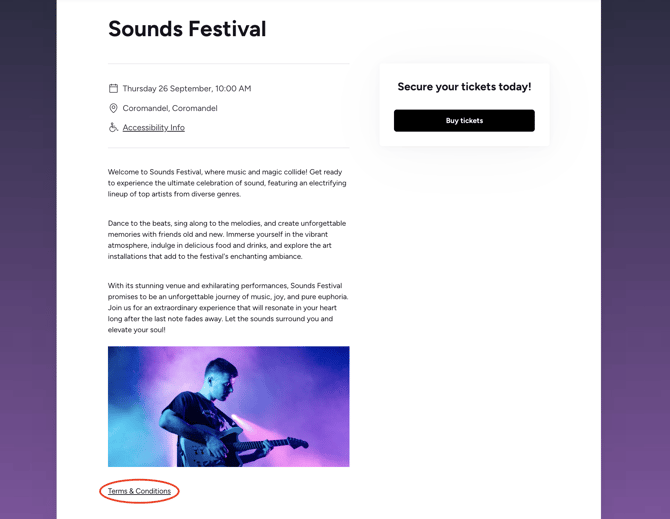
You must set your general T&Cs here, even if you have different T&Cs for different events (you can add event-specific T&Cs to your event in advanced settings of the event setup).
Quick links:
- What to consider in your terms & conditions
- Potential exposure without them
- Feature specific considerations
- Resources
- Where do terms and conditions show to customers?
Why this matters
Your T&Cs are the agreement every ticket buyer accepts at checkout. They set the ground rules for things like refunds, exchanges, ticket transfers, entry conditions and what happens if an event is postponed or cancelled.
They also directly shape the support your customers get. When a ticket buyer contacts support with a question or dispute — a refund request, a transfer, a postponed event — our support team refers back to your T&Cs to resolve it. Clear terms mean faster, consistent answers for your customers. Without them, every enquiry becomes a judgement call that has to come back to you, which slows your customers down and creates extra work for your team.
What to consider in your T&C's
What good T&Cs should cover
- Refunds, exchanges and what happens on cancellation or postponement
- Ticket transfers and resale — whether they’re allowed and on what conditions
- Conditions of entry (age restrictions, ID, prohibited items, right to refuse entry)
- Liability and assumption of risk
- How customers can contact you
And your privacy policy should explain
- What personal information you collect from ticket buyers and why
- How it’s used (e.g. ticket delivery, event updates, marketing — and how to opt out)
- Who it’s shared with, how it’s stored, and how long it’s kept
- How customers can access, correct or delete their information, and who to contact'
Where you’re exposed without them
- Refunds and chargebacks: with no agreed refund policy, it’s much harder to contest chargebacks or decline unreasonable refund requests — card schemes and banks generally side with the cardholder when there are no terms to point to.
- Disputes: if something goes wrong (cancellation, postponement, venue change), there’s no agreed position to fall back on — default consumer law applies, which is usually less favourable to you than well-drafted terms.
- Entry and conduct: without conditions of entry (age limits, prohibited items, right of refusal), enforcing decisions at the gate is harder to justify.
- Privacy compliance: you’re collecting personal information from every buyer. In most places you’re legally required to tell people how you collect, use and store it — that’s what your privacy policy does.
Feature specific considerations
1. Exchange terms
- That exchanges are offered at the organiser's discretion, not as a right
- That exchange credit is applied at the face value of the original ticket only
- That booking fees, transaction fees and any optional add-ons are non-refundable and not credited
2. Resale terms
- How resale works, and that it's facilitated but not guaranteed
- That the seller is refunded the amount they paid less booking and transaction fees
- Any restrictions on resale outside authorised channels (believe this is already covered)
3. Ticket Protection terms
- That it's an optional add-on selected at the point of purchase
- That the premium is non-refundable once purchased, including on exchange, transfer or resale
- Ticket protection does not carry over to exchanged orders and they will need to re-purchase this for exchanged orders
- A link to the provider's terms so customers can see what is and isn't covered
Resources
NEW ZEALAND
As you’re selling in New Zealand: the Consumer Guarantees Act 1993 and Fair Trading Act 1986 apply to your ticket sales. Buyers have rights you can’t contract out of (for example when an event is cancelled), and your terms must not be misleading — but well-drafted T&Cs let you set clear rules for everything else, like change-of-mind refunds and transfers. The Privacy Act 2020 requires you to be transparent about how you collect and use buyers’ personal information, which is what your privacy policy covers.
Where to get help: business.govt.nz has plain-English guidance on customer terms, and the NZ Law Society’s “Find a Lawyer” service can point you to a suitable practitioner. For your privacy policy, the Privacy Commissioner offers a free privacy statement generator (“Priv-o-matic”) at privacy.org.nz — a great starting point for small to medium organisations.
AUSTRALIA
As you’re selling in Australia: the Australian Consumer Law gives buyers guarantees you can’t exclude (for example refund rights when an event is cancelled and not rescheduled), and several states (including NSW, Victoria and Queensland) have specific ticket resale and scalping rules worth reflecting in your terms. If the Privacy Act 1988 applies to your organisation, you’re required to have a privacy policy explaining how you handle personal information — and it’s best practice regardless of size.
Where to get help: business.gov.au (“Legal essentials for business”) covers what terms and conditions should include, and your state or territory Law Society / Law Institute runs a lawyer referral service to connect you with a commercial lawyer. For privacy, the OAIC (oaic.gov.au) publishes guidance on what a privacy policy must contain.
UNITED STATES
As you’re selling in the United States: consumer protection is largely state-by-state, and several states have specific rules on ticket refunds, resale and fee disclosure. The FTC also acts against unclear or deceptive sales practices, including around fees and refund policies. A growing number of states (California, Colorado, Virginia and others) have privacy laws requiring you to disclose how you collect and use customers’ personal information. Given the state-level variation, we’d recommend having your attorney review your terms.
Where to get help: your state bar association runs a lawyer referral service (the American Bar Association keeps a directory at americanbar.org, or see findlegalhelp.org), and the FTC publishes business guidance on advertising, fees and refund practices at ftc.gov.
Where do terms and conditions show?
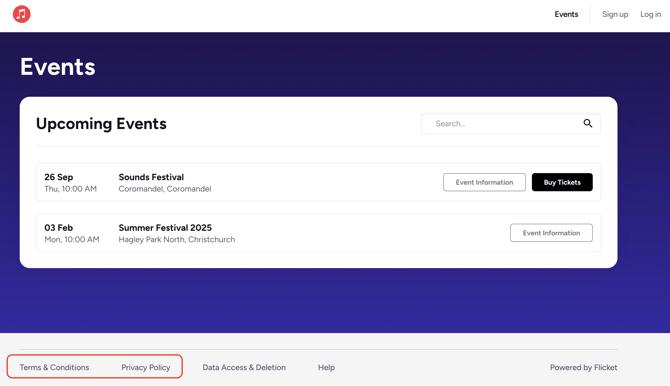
The general T&Cs and privacy policy will appear as a tab at the bottom of the customer portal:
Each event will have a link to the event T&Cs. If you do not enter event-specific T&Cs then it will automatically pull through the T&Cs from your organisation's settings. If you do have event-specific T&Cs then these will appear in this link.